Human Identity Architecture Is a Structural System
One of the most common assumptions about identity is that it is either fixed or constantly changing.
Neither is entirely true.
When people say identity is fixed, they often mean that who we are cannot meaningfully develop. When people say identity is always changing, they often blur together identity itself with everything that surrounds it, including beliefs, roles, behaviours, relationships, self-concept, emotional states, and life circumstances.
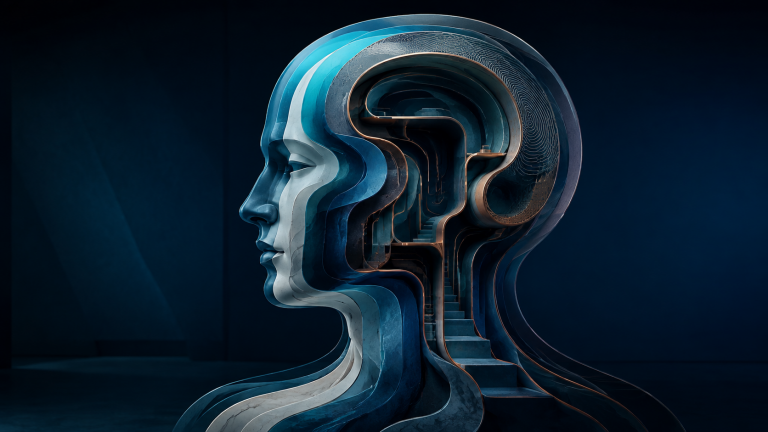
In my work, identity refers to the core organising structure that shapes how a person perceives, responds to, and expresses life. Based on my observations, it behaves like a constrained attractor system. It is not a collection of traits, roles, stories, beliefs, emotions, or labels. Those are expressions or interpretations of identity, not identity itself.
Identity remains relatively stable in its underlying constraints and organising tendencies. What changes far more dramatically throughout life is the architecture through which identity is accessed, interpreted, expressed, and organised.
That wider system is what I call identity architecture. Identity is what organises. Identity architecture is how that identity is lived.
Identity Architecture Is a Dynamic System
Identity architecture is not static. It is a dynamic, self-organising system that responds to internal conditions, external pressures, relationships, developmental demands, life events, and accumulated experience.
It includes:
- The Structural Identity Core
- Adaptive Identity Organisation
- Interpretative Narrative
Together, these layers influence how identity is expressed in the real world.
As circumstances change, adaptive strategies develop, narratives evolve, and access to different aspects of identity fluctuates. A person may appear very different at forty than they did at twenty, yet certain organising patterns often remain recognisable throughout their life.
This is why behaviour alone tells us very little about identity.
Behaviour changes. Roles change. Beliefs change. Self-concept changes.
Identity architecture reorganises. However, the core organising structure remains surprisingly consistent.

Why People Sometimes Feel Like They Have Become Someone Else
Many people experience periods where their old understanding of themselves no longer fits. The role that once defined them loses meaning. The goals that once motivated them lose their pull. The explanations that once made sense no longer satisfy.
This can feel as though identity itself is changing. Often something else is happening.
What is changing is the organisation of the system around identity. Adaptive patterns may be loosening. Old narratives may be dissolving. Previously inaccessible aspects of identity may be becoming available. Internal drivers may be shifting.
The person feels different because the architecture through which identity is expressed is reorganising.
From the inside, this can feel like becoming someone new. Structurally, it is often a process of becoming able to access, express, and organise more of what was already there.
Not Every Loss of Clarity Is a Problem
One of the most damaging assumptions in personal development is that clarity should always increase. Reality is often more complicated.
Identity architecture moves through recurring periods of stability and reorganisation.
There are phases where existing structures begin to loosen before new ones have stabilised. There are periods where familiar strategies stop working. There are times when certainty decreases before deeper coherence becomes possible.
In my framework, these are understood as identity system cycles rather than personal failures. Identity system cycles describe recurring phases through which identity architecture reorganises over time. They reflect changes in access, distribution, interpretation, and expression rather than changes to identity itself.
A temporary reduction in clarity does not automatically mean something is wrong. Sometimes the system is reorganising around conditions that can no longer be accommodated through existing structures.
The problem is not the loss of certainty itself but assumption that certainty must be restored immediately.

Coherence Is Dynamic, Not Permanent
Coherence is often misunderstood as a final destination.
As though there comes a point where confusion disappears, questions stop arising, and identity remains permanently stable.
Complex systems do not work that way. Coherence is not permanent certainty. It is the system’s ability to organise itself in ways that remain workable under changing conditions.
A healthy identity architecture can lose coherence temporarily and regain it. It can reorganise. It can adapt. It can integrate new realities. It can encounter pressures that expose limitations in its current organisation.
The goal is not to avoid all future disruption. The goal is increasing flexibility, resilience, and the ability to return to coherence without fragmentation. As development progresses, coherence often becomes less rigid and more robust. It no longer depends on having all the answers.
Development Is Not About Becoming Someone Else
A great deal of self-development is framed around transformation. Become a new version of yourself. Reinvent yourself. Create a new identity. The language sounds appealing, but it often obscures what is actually happening.
Development does not require abandoning identity. It involves increasing access to what is already structurally present, expanding the capacity to hold and express it, and reducing the distortions that limit its expression.
The question is not: “Who should I become?”
The deeper question is: “What is already organising me, and how much of it is actually available?”
Beyond Adaptation
We spend much of life adapting. We adapt to family systems, relationships, culture, expectations, workplaces, and circumstances. Adaptation is necessary but adaptation is not identity.
At some point, many people begin to notice that understanding their adaptations does not fully explain what sits underneath them. They understand the patterns, the coping mechanisms, and the stories. Yet something more fundamental remains unnamed.
This is where identity becomes an object of inquiry. Not as a personality profile, label or a role. But as an organising structure that shapes how the entire system functions.
A Self-Organising System, Not a Fixed Object
Identity is neither a rigid thing nor an endlessly shifting one. The Structural Identity Core remains relatively stable. Identity architecture does not. It reorganises throughout life. It moves through cycles of dissolution, reorganisation, expression, integration, and saturation.
As access increases, capacities develop, distortions loosen, and governance becomes more available, the system becomes capable of expressing more of its inherent range. What changes is not identity itself. What changes is how much of it can be accessed, held, expressed, organised, and lived.

Where this leads next
Some people arrive here because they recognise themselves in the writing. Others arrive because they have lived through a process that deserves more accurate language.
You can explore the work more fully through the frameworks, essays, Blueprint, and one-to-one identity development options. Or, if your own experience speaks to identity threshold, reorganisation, healing, development, or structural change, you are invited to contribute to the research.