
A structural map of what organises you beneath adaptation
The Identity Blueprint offers an initial orientation to possible core organising tendencies beneath your identity expression.
It develops a provisional map of structural tendencies, capacities, sensitivities, constraints, pressure points and developmental themes that may remain recognisable across life, even when your roles, self-concept, behaviour and external circumstances change.
It does not tell you who to become.
It does not describe a fixed self.
It does not promise clarity that lasts forever.
It can serve as an optional starting point before Identity Development Sessions or as a gateway into self-led identity development, especially when identity feels unstable, distorted, over-adapted or difficult to name. The Blueprint does not develop identity in itself. It helps speed up orientation, gives structural work direction and provides a reference point for ongoing observation.



How identity is understood here



In this work, identity refers to the Structural Identity Core: the deeper organising structure that shapes perception, response, direction, capacity, and expression.
That core does not exist in isolation. It is lived through a wider identity architecture, including adaptive patterns formed through pressure, survival, belonging, and conditioning, as well as the narratives and beliefs used to explain who we are.
Over time, adaptation and narrative can obscure, distort, or overtake access to the deeper structure. What many people experience as “losing themselves” is often not the disappearance of identity, but the dominance of adaptive organisation.
The Identity Blueprint offers a starting point for exploring:
- what may reflect structural tendencies
- what may reflect adaptive organisation
- what may indicate distortion or an immature expression of an innate capacity
- what may be emerging or still developing
It is not a final verdict, and it does not perform differentiation by itself. It provides provisional hypotheses and a structural reference point that can be tested against lived evidence.
The Identity Blueprint is
a structural map of core identity tendencies, capacities, sensitivities, and constraints
a lens for recognising long-term identity patterns across life phases
a way to distinguish structure, adaptation, distortion, and maturity
a reference point during periods of transition, threshold, or reorganisation

The Identity Blueprint is not:
a personality label
a predictive tool
a fixed definition of self
a substitute for responsibility, discernment, or lived integration
What the Blueprint includes
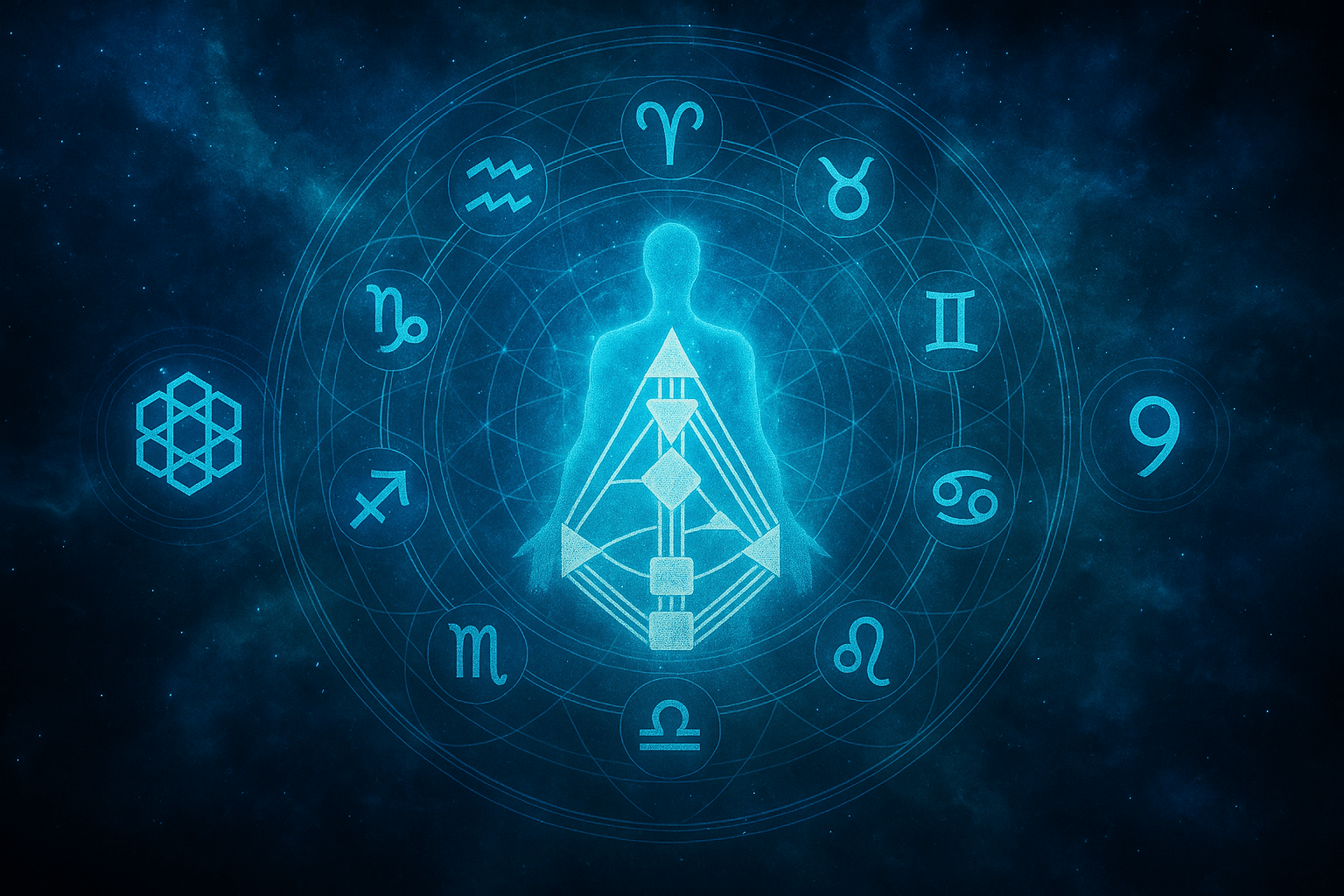
The Identity Blueprint draws from multiple symbolic systems, including astrology, Human Design, Gene Keys and numerology, interpreted through a structural identity framework and translated into grounded identity language.
These systems are not treated as identities to adopt, belief systems to follow, or definitive explanations of who a person is. Instead, they are used as structured symbolic maps that may contain information about recurring tendencies, capacities, sensitivities, constraints, and developmental themes. No single system is treated as sufficient on its own. The emphasis is placed on pattern convergence, structural interpretation, and how recurring themes relate to lived experience over time.
Rather than listing data points, the work focuses on patterns such as:
- core identity capacities and orientation
- natural sensitivities and pressure points
- maturity and distortion trajectories
- repeating adaptive strategies
- long-term identity themes
- areas of possible reorganisation or emergence
The emphasis is on structural interpretation and hypothesis formation, not information for its own sake. Differentiation develops through comparison with lived experience and, where needed, observation across time.
What the Blueprint Can and Cannot Tell You
The Identity Blueprint is not intended to provide a complete or definitive description of a person. Rather than presenting a fixed or final account of identity, it is best understood as a structural orientation map: a starting point for recognising patterns, tendencies, capacities, sensitivities, constraints, and developmental themes that may exist beneath adaptation, self-concept, behaviour, and life circumstances.
The Blueprint is based on pattern convergence rather than certainty. It draws on multiple symbolic systems, including astrology, Human Design, Gene Keys, and numerology, not because any single system is treated as absolute truth, but because recurring themes sometimes emerge across multiple sources. These themes are then interpreted through the lens of identity structure, adaptation, development, and lived experience, allowing for a more nuanced and layered understanding.
The resulting map is not intended to replace observation, reflection, inquiry, or experience. Instead, it offers an initial orientation that can be explored, refined, challenged, expanded, or revised through ongoing observation and identity work. It is a tool for engagement rather than a conclusion to accept.
In some cases, the Blueprint may feel immediately recognisable, resonating with aspects of experience that have already been noticed or understood. In other cases, certain elements may only become meaningful over time, revealing their relevance through lived experience and reflection.
Ultimately, the purpose of the Blueprint is not to tell you who you are. Its purpose is to offer a framework for exploring what may be organising you, inviting a deeper and more ongoing process of discovery.
How the Identity Blueprint is Created
The Identity Blueprint is created through a structured analysis and synthesis of multiple symbolic systems, supported by AI-assisted pattern recognition and my own interpretive process.
Because these systems are based on fixed birth and name data rather than self-reporting, they provide a source of information that is independent of a person’s current self-concept, preferences, adaptive narratives, or how they describe themselves.
This does not prove identity, nor does it guarantee accuracy. Rather, it provides a stable starting point from which recurring patterns, tendencies, and structural themes may be explored.
The Blueprint itself is not a direct output of any single system. It emerges through interpretation, synthesis, pattern recognition, and the identification of recurring themes across multiple sources.
From there, the work translates symbolic material into structural identity language.
The focus is not prediction, destiny or external authority. It is the identification of possible structural tendencies, capacities, sensitivities, constraints, pressure points and developmental themes. The report may also suggest where an innate capacity is being expressed immaturely or where a pattern may reflect distortion, constraint, adaptation or narrative misinterpretation. These remain hypotheses to be considered against lived experience.
Where appropriate, and only within the right container, additional insight may be brought in through direct observation, dialogue, pattern recognition, and the person’s actual identity history.



How I work with the Identity Blueprint
I do not deliver the Blueprint as raw data.
Every engagement includes a written Identity Blueprint report, which offers a provisional interpretation of possible core identity tendencies, long-term patterns, adaptive distortions and developmental themes.
I work with the Blueprint through interpretation, language, pattern recognition, and structural perception. The aim is to help you see what may be organising your identity expression beneath behaviour, roles, self-concept, and inherited narratives.
In some cases, this work also includes a 90-minute interpretive session. In that session, we explore how the Blueprint relates to your lived experience, where adaptation may have shaped expression, what is currently active, and where identity may be reorganising rather than simply stabilising.
Any additional insight beyond the written report is shared only within the session, where there is enough context and relational containment for it to be useful.
This work can influence how you see yourself, and therefore how you choose. It does not direct outcomes.
Two ways to engage with the Identity Blueprint
Option 1: Identity Blueprint (Report Only)
A written report offering a provisional map of possible core structural tendencies, long-term patterns, capacities, sensitivities, likely distortions and developmental themes.
Best suited if:
- you want structural orientation without dialogue
- you are comfortable integrating insight independently
- you are not currently in an intense reorganisation phase
- you want a reference document you can return to over time
Choose the Blueprint only if you want the written structural map. This gives you a personalised document that you can return to over time. It is best suited for people who process well independently and want language, structure and orientation without needing a live interpretation.
The Identity Blueprint is not a diagnosis, prediction, therapy process, or personality label. It will not tell you what to do with your life or promise instant clarity. It is a structural orientation document, created to help you see what may be organising your perception, decisions, expression and development beneath roles, behaviour and self-concept.
Price:
Early access: £333
Standard price: £444

Option 2: Identity Blueprint + Interpretive Session
The written Identity Blueprint combined with a 90-minute interpretive session, where we relate its hypotheses to your lived experience, explore where adaptation may have shaped expression, and identify questions for further observation. This option is selective. It is offered when identity appears ready for interpretation without unnecessary destabilisation, overwhelm or premature definition.
Best suited if:
- you want help interpreting the Blueprint in relation to lived experience
- you are moving through threshold, transition, or reorganisation
- you can sit with complexity without needing immediate certainty
- you want help examining possible relationships between structural tendencies, adaptation and narrative
Choose the Blueprint with an interpretative session if you want help reading the map. The session is not a coaching session in the usual sense. It is a guided exploration of the Blueprint, helping you relate its most relevant hypotheses and developmental themes to lived experience without treating them as final differentiation.
Price:
Early access: £555
Standard price: £777
Important Info
The Identity Blueprint is created from your accurate date, time and place of birth. Because the map depends on time-sensitive structural placements, I need your birth time to be confirmed within approximately 15 minutes.
If you cannot confirm your exact birth time, this version of the Blueprint is not suitable. In that case, Identity Development Sessions are the better route, because the work would need to be built through structured inquiry, lived pattern tracking and observation over time.
That inquiry can still create a meaningful structural map, but it works differently. It is designed to reveal core tendencies, emerging capacities, adaptive patterns and narrative filtering through real-life evidence rather than birth-based mapping alone. Due to the nature of this work, that cannot be responsibly completed in one or two sessions.
After purchase
After payment, you will receive a short form where you can provide your birth details and any relevant context. If you have purchased the Blueprint with an interpretative session, you will also receive a link to book your session.
Your Blueprint will be prepared personally. This is not an automated report. Delivery time is usually 5 working days from the point at which I receive the required details. Because this is a personalised service, work begins only after your required details have been submitted. Please read the terms before purchase, including cancellation and refund information.
Discovery Call: required for session-based work
Before booking the Identity Blueprint with an interpretive session, we begin with a Discovery Call. This is a 30-minute conversation to:
- assess readiness and suitability
- locate where you are in relation to identity work
- determine whether Blueprint work is appropriate now
- decide whether report-only or session-based work is the better fit
Not everyone is ready for this work. Not every phase benefits from interpretation. If the Blueprint is not the right next step, I will say so.
Important boundaries
This work does not:
- fix identity
- tell you who you are
- stabilise confusion prematurely
- replace self-leadership
- offer certainty or guarantees
- act as therapy, diagnosis, or crisis support
It assumes responsibility, reflection, and emotional maturity. If clarity keeps dissolving rather than stabilising, that may be part of the process – not a problem to solve.
The aim is not to force definition. The aim is to support more accurate perception of what is organising you beneath adaptation, narrative, pressure, and role.